Category: Reviews

  • ‘Mad Hot Ballroom’ is a delightful crowd-pleaser

    ‘Mad Hot Ballroom’ is a delightful crowd-pleaser

    The stars of ‘Mad Hot Ballroom’ are the students

    New York is a town that generally frowns upon the concept of prolonged eye contact. City kids learn early that locking eyes with someone is tantamount to a challenge. The deep stare is a bold move liable to provoke at the very least, annoyance (“Whadda you lookin’ at?”) or, more frighteningly, threats (“You lookin’ at me?”). 

    In light of this cultural characteristic, it seems improbable that since 1994, the American Ballroom Theater’s Dancing Classrooms program has insisted that thousands of eleven-year-old New York City public school kids not only lock eyes with each other, but swing their hips, hold hands, bow, curtsy and flash big, toothy grins — all in the name of the seemingly anachronistic art of ballroom dance.

    Mad Hot Ballroom documents this program’s surprising success and popularity, wisely capitalizing on the beguiling charm of its stars — the students themselves. 

    Watching a healthy amount of time spent at dance practice, we initially see our young protagonists struggle with rhythm, historical background and some awkward physical positioning that includes all that afore-mentioned eye contact. As this footage is supplemented with interviews, candid after-school snippets and a few background details supplied by instructors and school faculty, we see that the strange artificialities of ballroom dance unlock a real wealth of benefits, ranging from pride and poise to the arts of cooperation and compromise.

    Claudia Raschke-Robinson’s unobtrusive camera work captures all the qualities we love most about pre-teen kids. From towering elation to crestfallen dejection, we watch these kids unabashedly feel their way along the emotional spectrum. We listen to the endearing exuberance and terrifying honesty that flows through their conversations, and realize, with a little sadness, that the years of adolescent indifference and detachment loom just down the road. 

    Though it’s clear the program is conducted citywide, Director Marilyn Agrelo and Writer Amy Sewell divide screen time between three schools: P.S. 112 in Bensonhurst, TriBeCa’s PS150, and Washington Heights’ PS115. While the film’s most charismatic kids are based in TriBeCa and Bensonhurst, the comparatively poor Washington Heights team ultimately carries the lion’s share of the film’s drama, thanks to a Cinderella-story narrative arc and the force of will embodied in Yomaira Reynoso, the team’s doggedly determined teacher/advisor.

    Mad Hot Ballroom shimmies between schools to capture the wit and confidence evident in TriBeCa’s kids, the good-natured appeal at Bensonhurst, and the Washington Heights team’s competitive focus.

    If there’s criticism to file, it’s born of these shifts, which promenade our attention from one child to the next, foxtrotting over any sticky issues that lay in the subtext. This technique gives the film an entertaining levity, but robs it of any potential deeper meaning or true commentary. This is a minor objection, because ultimately, Mad Hot Ballroom turns out a delightful crowd-pleaser that merengues, foxtrots, swings, rumbas and tangos across the screen, daring its seat-bound audience not to twitch along with in time.

  • ‘Revenge of the Sith’ has beautiful action, but suffers from wooden words

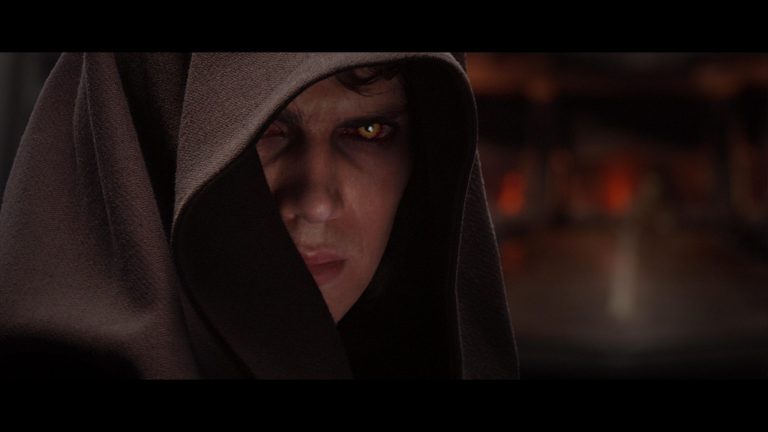
    Hayden Christensen and Ewan MacGregor in ‘Star Wars: Episode III – Revenge of the Sith’

    Since I am fortunate enough to live in Los Angeles I had hoped to see Star Wars: Episode III – Revenge of the Sith at the historic Chinese theatre. Sadly, this was not to be, as the powers that be chose not to open the film there for whatever reason, disappointing the legions who lined up there hoping to convince them to change their minds. Instead I purchased advanced tickets to see this gem on opening day at the world-famous Cinerama Dome with its 83 foot wide curved screen. It was disappointing to note that not all of the performances were sold out on opening day, but I blame that more on the choice to open the film on so many screens across the area rather than the choice of people to come see the movie in Hollywood, particularly on a weekday afternoon when traffic is a consideration.

    The ushers did their best, but there were several Darth Idiots to contend with who insisted on playing with their new light sabers ($16.95 with batteries included in the lobby), disrupting the trailers that were shown before the movie began. Happily, I think they understood that they probably faced the wrath of many of us who wanted to be able to focus on the screen without distraction and refrained from using their toys once the opening credits were complete.

    With prequels and serials you know where the story left off and where it is going, so I am not going to tell you a lot and particularly intend to avoid spoilers. Suffice it to say that storywise, this is the best of the first three episodes, as Director/Writer George Lucas weaves a tale worthy of his talents with sufficients twists and turns to keep the audience on the edge of their seats in the brief lulls between the wonderful action sequences.

    And it is action that Lucas does best, perhaps better than anyone else. The battle sequences are magnificent, whether they involve ship against ship or warrior against warrior. It is when battles change from weapons to words that Lucas loses his way. If only his strength of story and character arc were present in his ability with dialogue as well.

    The Republic, still led by Chancellor Palpatine (Ian McDiarmid) is still at war and the Jedi Knights are leading the Republic’s clone forces in battles throughout the galaxy in an attempt to defeat the separatists who are being led by General Grevious, who has just kidnapped Palpatine himself. Obi-Wan Kenobi (Ewan McGregor) and his apprentice Anakin Skywalker (Hayden Christensen) are dispatched to rescue the chancellor before Grevious can spirit him away.

    As a director of actors, Lucas manages to evoke performances of varying degree from them. McDiarmid is ordinary in a role that could have been much more. Ewan McGregor is brilliant as the younger Obi-Wan Kenobi, who is portrayed in Episodes IV through VI by Sir Alec Guiness. His passion and zeal as a Jedi Knight dedicated to preserving the freedom and liberty of the Republic are evident throughout everything he says and does, and he lets it all hang out in his final confrontation with Anakin. Natalie Portman’s performance as Padme Amidala may be physically restrained by the fact that her character is pregnant with the twin children of Anakin, but that doesn’t keep her from delivering just the right emotional note, time and time again.

    However it is Hayden Christensen who truly shines through as Anakin Skywalker/Darth Vader, who is passing through that transformation from good to evil, and for what he would argue is the purest of reasons: true love. While I doubt the Academy of Motion Picture Arts and Sciences will view his performance as worthy of a nomination at award time, so far in 2005 it is one of the finest performances I have seen. The love that drives him to the dark side of the force isn’t just written on his face, it is a part of every fiber of his being. He manages to display all of his emotions, often without a single word being required to let us know what he is feeling. This is a rising actor who is truly at the top of his game in this movie.

    Again, not to say that Episode III is perfect, it isn’t. There is a battle scene where three Jedi are killed much too easily and the only reason that this could have happened is that Mr. Lucas needed to speed the scene up for expediency’s sake. I may be harping on the horrid dialogue, but there are moments when it is truly wooden. However, Episode III is leaps and bounds better than Episodes I and II and left me wishing that somehow, someway Episodes VII through IX would someday be made. There are some who believe it will happen. George Lucas is a multi-billionaire and he is the kind of straightforward person who says what he means and means what he says. He says it won’t happen.

    Sadly, I believe him.

  • ‘Kinsey’ makes a movie about sex something more than just a movie about sex

    Liam Neeson talks sex with Laura Linney in 'Kinsey'
    Liam Neeson talks sex with Laura Linney in ‘Kinsey’

    Let’s talk about sex.

    Okay, that’s a pretty wide ranging subject. How about we narrow it down a few notches and talk about Kinsey, the biopic of Dr. Alfred Kinsey starring Liam Neeson. The film charts the good doctor’s relationship with his wife, Clara, and how he developed and fought to conduct his study on the sexual practices of human beings.

    His study, which spanned the 1940s and into the 1950s, detailed male and female sexual activities, as well as the physical nature of sexual intercourse. No study of its kind had ever been done, with books and theories based largely on societal and religious beliefs and not factual evidence.

    For example, before Kinsey, it was often believed that masturbation could cause blindness; oral sex could cause pregnancy; and other equally idiotic notions.

    What I find most fascinating about films like Kinseyis how they provide an insight into a period of time. It may seem strange in this day and age to think that the understanding of sexual behavior and practices were so limited, and ruled largely by false rumors. Mind you, there is still a certain level of sexual repression in society today, but clearly not nearly on the same level as it was pre-Kinsey.

    As Kinsey portrays it, sex was considered something solely used for procreation. That sexual behavior and thoughts were often seen as perverted and/or sinful. Kinsey helped change this stigmatism, and perhaps helped contribute to the eventual sexual revolution that would come in the late 1960s and 1970s.

    The film itself is beautifully told and acted. Neeson delivers one of his best, most honest performances. He is also accompanied by a terrific cast, which includes Laura Linney, who is understated as Kinsey’s free-spirited wife. Peter Sarsgaard, Chris O’Donnell, and Timothy Hutton also do quite well in their supporting roles. John Lithgow offers a terrific dramatic performance as Kinsey’s narrow-minded and verbally abusive father.

    Like Kinsey’s approach to studying the sexual behavior of human beings, writer/director Bill Condon remains true and honest about his subject. For better or worse, Kinsey is shown as a dedicated scientist whose very dedication takes a toll on his health. His emotional detachment often leaves him blind to the effect his study has on others, including the members of his research team.

    This is ultimately the flaw that I think the film version of Kinsey carries. Throughout he remains determined to understand human sexuality, but refuses to recognize or acknowledge the emotional element that naturally exists. That sex carries with it feelings and emotions that are often unavoidable, as most things are when humans are involved.

    Unfortunately, the DVD version of Kinsey that I received is the bare-bones edition, which has no special features other than an audio commentary featuring Condon. There are some interesting little tidbits in the commentary, but it’s a little dry.

    In the end, Kinsey was one of the finest biopics I’ve seen in years, offering a sense of honesty and social commentary that didn’t feel preachy or melodramatic.

  • Daniel Craig explodes in ‘Layer Cake,’ a smart, slick flick that rarely stops moving

    Daniel Craig explodes in ‘Layer Cake,’ a smart, slick flick that rarely stops moving

    Daniel Craig and Colm Meaney in 'Layer Cake'
    Daniel Craig and Colm Meaney in ‘Layer Cake’

    I’m not sure why, but the Brits seem obsessed with fast-paced, super edited crime thrillers where there are no real good guys, just a bunch of bad guys trying to one-up each other.

    That’s pretty much the concept behind Layer Cake, but that doesn’t mean it’s not entertaining. In fact, it’s actually a pretty good movie.

    Daniel Craig stars as a middle man in the drug trade in England. Along with his crew, they successfully distribute and sell their product for their boss, Jimmy. But Craig’s character (whose name is never revealed) is planning to retire. He’s made a lot of money, and is looking to get out of the business. But Jimmy delivers one last task: find Charlotte Ryder, an old friend’s daughter.

    While he struggles to locate the girl, his crew is also tasked with examining the quality of two million pounds of ecstasy, which turns out to be stolen from a gang of neo-Nazi killers. Twists and murders come at every turn, keeping Craig’s character on the run for his life.

    Left to right: George Harris, Colm Meaney and Daniel Craig co-star in 'Layer Cake'
    Left to right: George Harris, Colm Meaney and Daniel Craig co-star in ‘Layer Cake’

    I liked this movie. It was smart, slick and rarely stopped moving. Craig does a great job as the man with no name. In fact, everyone in the cast turns in a crisp performance, including Colm Meaney, one of my favorite actors from Star Trek: Deep Space Nine. He’s one of the few people to grace a Trek series that has managed to retain a varied career.

    Meaney is not the only Trek vet in Layer Cake. Although I shiver to even mention it, Tom Hardy, who plays Clarkie, a member of Craig’s crew, played the evil Picard clone, Shinzon, in Star Trek: Nemesis.

    There’s a dark, cynical tone to Layer Cake that is pervasive in most crime thrillers that come from England. But it still works, and a large part of that is due to the cast. George Harris, whose been in quite a few things I’ve caught lately, would probably be most recognized as the boat captain in Raiders of the Lost Ark (he was also recently in The Interpreter). His character is the most complex, and was a stand out performer for me.

    I say he was the most complex because while other characters like Craig’s man with no name and Meaney have more screen time, both are pretty much as you see them. Although their pasts are largely mysterious, you know who they are from the very beginning. With Harris’ Monty, you’re not too sure what he’s about. Plus, there’s one scene in particular where he beats the snot out of a homeless man, where you begin to understand that this is the only character who has depth.

    As for the rest, they are who they appear. There isn’t any complexity to them, and quite honestly, there doesn’t need to be. Layer Cake itself is complex enough, with nothing but twists and turns, right up to the very end.

  • ‘Z Channel: A Magnificent Obsession’

    Z Channel: A Magnificent Obsession (2004) documentary
    Z Channel: A Magnificent Obsession (2004) documentary

    When I first got a copy of this documentary back in April, I had this strange feeling that I’d heard of Z Channel. However, I had no idea what it was, it just seemed vaguely familiar. Like I’d heard it somewhere before, but had no memory of where or in what context. So when I watched the documentary, it was a completely new experience for me.

    Z Channel was one of the first cable channels during the late 1970s and 1980s that aired only in the Los Angeles area, so my ignorance of its existence has a logic. I grew up on the east coast, and while I loved movies, I didn’t even have cable until I was a teenager. So there really wasn’t any way I could have seen it, but after having watched Xan Cassavetes’ Z Channel: A Magnificent Obsession, I wish I had.

    The eclectic array of films that were presented on Z Channel was extraordinary, and the rise and fall of the channel is ultimately connected to its most famous — or perhaps infamous — programmer, Jerry Harvey. It is this fine line between these two stories that Z Channel skirts, and skirts well.

    Jerry Harvey was a film lover and programmer who headed Z Channel at the height of its popularity throughout most of the 1980s. Its success, which rivaled that of HBO and Showtime, was largely accredited to him and his varied film tastes. He helped save or make the careers of such artists as Michael Chimino, James Woods, and Paul Verhoven. His involvement in presenting such a wide array of films also helped develop the idea of “director’s cuts”, which has become something of a staple in the film industry today.

    However, his tragic murder/suicide completely altered the perception of the man for most people, and without him Z Channel slowly faded into obscurity. However, Z Channel, the documentary, brings this often forgotten chapter of television history back to light.

    For the most part, the documentary is fairly engrossing. It’s perfectly balanced between the highs and lows of Harvey’s life, but never strays too far away from the main subject, which is the channel itself. The effect it had on many filmmakers and individual movies is impressive, and the pure scope of films it showed is amazing. Undoubtedly you would never find something like it on cable now, because it really wasn’t about one type of movie or another. It was basically about everything and anything, and that was its charm.

    However, while the information about Z Channel is interesting, you are ultimately drawn the to tragic story of Jerry Harvey. This is where most of the film’s drama lies, and it is sad to see how this man who seemed so creative could ultimately destroy himself. And the anger of those who knew him is still visually palpable. Throughout the film there is an audio interview of him which is creepy in how it seems to sound like he is talking from the grave.

    My only problem with Z Channel is, aside from the Harvey story, the film doesn’t offer much after the first hour. It moves from one film to another that was shown and championed by Harvey and the channel, but it gets a little repetitive. None of these bits really differ much, so the film ends up becoming a bit dry.

    Still, Z Channel’s mark on the film industry, and cable television, is made clear in the documentary. The tragedy is not only limited to the death of Jerry Harvey, but the way in which such an important piece of history like Z Channel seemed to have been discarded and virtually forgotten. If nothing else, Xan Cassevetes should be congratulated for bringing it back into the public consciousness.

  • ‘National Treasure’ is a fun adventure film, with an equally fun DVD to boot

    Nicolas Cage steals the Constitution of the United States in 'National Treasure'
    Nicolas Cage steals the Constitution of the United States in ‘National Treasure’

    It’s funny sometimes how a movie can be so preposterous, yet manage to still remain fun and entertaining that you enjoy it regardless. That’s the best way to describe my experience watching the National Treasure DVD this past weekend.

    The story itself is rather over the top, more often than not stretching the limits of believability. But the snappy dialogue, great chemistry among the stars, and the silliness of the plot really help make you just sit back and relax your brain. You’re better off not really considering whether or not much of the story is realistic, just enjoy the ride.

    National Treasure follows Ben Gates’ search for the historic treasure of the Masons. Long since hidden through a series of vague clues, most believe it does not exist. But the secret of the treasure has been passed down through generations of the Gates family, and Ben Gates has dedicated his life to finding it.

    After discovering an important clue in a wooden ship buried in the North Pole, Gates learns that a map revealing the location of the treasure is on the back of the Declaration of Independence. But just as he makes this important discovery, Gates is betrayed by his partner for the past two years (Sean Bean), and nearly killed.

    Knowing that his former partner plans to steal the Declaration, and possibly destroy it, Gates decides he must steal the historic document before his ex partner does. With the help of a computer geek, he manages to get his hands on the fabled map, and then it’s a race through several historic locales in Philadelphia and New York to find the treasure.

    The story races through the first few scenes in order to get to film’s key moment, which is the theft of the Declaration of Independence. Much of this all comes off as ludicrous, but like I said, you have to let your brain take a snooze here. Sure, it’s basically preposterous, but that doesn’t mean it’s not fun.

    Much of National Treasure’s charm comes through the banter between Nicolas Cage’s Ben Gates and his sidekick, the computer-savvy Riley Poole, played by Justin Bartha. Their exchanges are funny and snappy, showing a rare kind of chemistry between the two actors. This is highlighted by Diane Kruger, who comes into the story as Cage’s love interest. This trio really helps you forgive the film’s flights of fancy.

    Aside from the sequence surrounding the theft of the Declaration, the rest of the film is surprisingly low key. There are a few chases, but none of them are terribly elaborate, and the climactic action is also surprisingly low key. For a Jerry Bruckheimer film, you expect a lot of over the top, explosive action. Here we’re given some tame action sequences, but ultimately they fit in with the tone of the film.

    Now, regardless of how you may or may not feel about National Treasure, it is impossible to deny that this DVD is probably the most inventive one to come down the pike in quite some time. Keeping in the spirit with the movie itself, the “treasure” of special features found on the DVD are uncovered through various clues you receive upon watching the special features.

    When you first visit the bonus section of the disc, you’re only given a small sampling of features (deleted scenes, one behind the scenes doc, etc.). They are good, but you may see them as being slightly dry. Plus, the back of the DVD case suggests there are more features.

    In order to unlock more special features, you need to gather up all the clues. These clues come in pairs of letters you get upon watching certain featurettes. These clues are saved on the disc, and once you have them all, you need to unscramble the letters and figure out what they spell. Now, it’s really not that difficult to do, but once you do it you’ll be given access to more special features.

    I attended a special presentation by Disney a few months back about this, and honestly thought it was pretty clever. And now that I’ve gotten a chance to actually do it, it does make the DVD viewing experience a little more interactive. Plus, as you get deeper into the DVD’s bonus material, the features get more interesting.

    National Treasure is a fun ride, one that you can easily share as a family since much of the action is pretty tame. And the DVD’s special gimmicks help make viewing the entire DVD a fun experience.

  • ‘Enron: The Smartest Guys in the Room’ damns the execs, ignores the victims

    ‘Enron: The Smartest Guys in the Room’ tells a damning story of corporate greed

    “Ask Why.” It was Enron’s leading promotional tagline. Maddeningly, if the colossal debacle that is the Enron story has a moral, the lesson to be learned also appears to be “ask why.” 

    Based on The Smartest Guys in the Room, a best-selling analysis by Fortune magazine reporters Bethany McLean and Peter Elkind, Enron: The Smartest Guys in the Room presents a morbidly compelling look at the Darwinian economics and cutthroat business philosophy that birthed a company constructed with smoke and mirrors and run on moral corruption. 

    The beauty of writer/director Alex Gibney’s film is in the sense it makes of the (intentional) information mire Enron used as a business model — a mire that muddied even the aftermath of the scandal. When the company crashed in August, 2001, the greater part of the American public was left with a fuzzy information hangover. 

    We knew about the rolling blackouts in California. We saw the boxes and boxes of shredded paper carted out of the Arthur Andersen accounting offices. We knew Enron had something to do with energy and maybe something to do with direct TV. We knew Enron had big bucks and slick commercials. The hard part was putting a finger how all that tied together. Enron does this well, avoiding that big stumbling block one needs to address in making a paper trail doc like this one — how do you get a movie audience to sit through 150 minutes of suited white guys talking? 

    Gibney moves his story along on the backs of the antagonists themselves, Enron executives Ken Lay, Jeffrey Skilling, Andy Fastow, and to a lesser extent, the late Cliff Baxter, who committed suicide as Enron’s house of cards collapsed. This decision is generally a good one, although it ultimately makes the story lopsided. While we’re treated to a lengthy look at the executives, the victims of Enron’s white-collar crimes are bit players, swept aside in the retelling almost as much as they were in the real story.

    A minor storytelling judgment lapse also arises during Enron Energy Services CEO Lou Pai’s subchapter, in which we learn (news flash!) that high-powered executives enjoy the services of strippers. A healthy amount of screen time is spent in a strip club while we learn how this chilly intimidator spent his off hours, a choice that doesn’t work to advance the story or tell us anything.

    Overall, Gibney treats his material with a light touch, editorializing in little more than clever musical lead-ins and pithy chapter headers. The most damning commentary Enrondelivers comes straight from the mouths of the executives and traders, via corporate audio and video clips. 

    In these conversations we hear the nervy arrogance in their voices and understand the hubris with which they justified their evil deeds. These are men who literally (yes, you can hear them) laughed while California burned during 2001’s season of rolling blackouts, actively shutting down power companies to feed on the resulting price spikes. 

    Enron’s tale of power and corruption brought down by pride and avarice has the makings of great dramatic fiction. With a small army of larger-than life enemies threatening scores of ordinary, everyday people, what’s really missing here is a knight in shining armor, and that may be the most alarming aspect of Enron. The bad guys pillage, the people suffer, and we’re all left with the realization that it can (and likely will) happen again unless watchdogs watch and the rest of us care enough to ask why.

  • ‘A Tale of Two Sisters’ is a creepy Korean tale with lots of tasty twists and turns

    Im Sun-yeong and Yeom Jeong-ah are sisters in 'A Tale of Two Sisters'
    Im Sun-yeong and Yeom Jeong-ah are sisters in ‘A Tale of Two Sisters’

    A Tale of Two Sisters is the second Korean film I’ve had the opportunity to view in the last few weeks, and so far I have to say that some interesting movies are making their way west from that divided nation.

    Now, let me first note that normally a review of a horror film would be relegated to our illustrious Horror Guru. However, when I received this DVD for review, I wasn’t exactly sure what to make of it. Was it horror? Was it a psychological thriller? Even after watching it, I think it skirts the edge a bit. You could argue that it’s a classic gothic horror, in tone with something like The Others; but at the same time it could be compared to the excellent classic, Gaslight, which is a thriller.

    Trying to categorize films can be a challenge sometimes, especially when they appear to have several different elements. If you want a good example, try to tell me whether the television series, Lost, is science fiction or a drama.

    Either way, this DVD was released before I could effectively pass it over to our Horror Guru, and I’m still not completely sold on the idea that this is really a “horror” movie.

    Getting back to the film, A Tale of Two Sisters — which was released in Korea back in 2003 — is about a family that is struggling to rebuild its life after a terrible tragedy. What exactly that tragedy is remains a mystery for the majority of the film, but things get darker and creepier as we meet the two sisters.

    The often absent father leaves them in the care of his new wife. The stepmother, however, is on medication and is clearly troubled. As strange things begin to happen around the house — like a mysterious ghost who haunts the two sisters — the stepmother becomes increasingly violent.

    Yet things aren’t all as they seem, as several twists soon lead you to question everything you’ve seen and heard.

    The twists and turns the story goes through in the second half do become apparent earlier, but when they happen I have to say, they’re pretty smart. Although I thought the film was a tad slower than it needed to be, I enjoyed it. It’s a smart suspense film, which is a rarity nowadays. There is also a certain level of ambiguity when the film concludes, which was interesting, if a little confusing at first.

    I think the best comparison one could make would be to Sixth Sense. It has the same pacing and tone. Director Kim Jee-Woon does a great job handling the story, and the visuals are outstanding. There is an artistry here that is not overtaken by too many cheap tricks. Yes, there are a few moments like quick cuts and sudden music meant to scare you, but they are balanced with slow, methodical images that work beautifully to build tension and suspense.

    The performances are also terrific. Su-jeong Lim as Su-mi is powerful, as is Jung-ah Yum, as the stepmother, Eun-joo. Of the entire cast, I think Jung-ah Yum had the most difficult time in the film, as she had to run the gamut of emotions. One moment she’s happy and polite, then switches almost instantly to methodical and evil.

    A Tale of Two Sisters gets its United States release as a two-disc set. The first contains the film, as well as two audio commentaries. The first features the film’s director, cinematographer and lighting director. The second had the director with some of film’s stars. Both are in Korean, with English subtitles, and contain a lot of great details about the making of the film.

    The second disc contains behind the scenes documentaries, interviews with the cast, and several deleted scenes. Each scene is accompanied with commentary from the director on why each was removed from the finished film. The commentary on some scenes is interesting, in that Kim Jee-Woon seems to question whether or not removing them really made the film better or not.

    All of the behind the scenes stuff is in Korean, with English subtitles. This isn’t bad, exactly, but to be honest after a while you get kind of tired of reading the subtitles. I would have liked it if they had provided an English soundtrack on the documentaries, which would have at least provided a break.

    Overall, I would say that A Tale of Two Sisters is a smart, terrific thriller. I have no doubt that there’ll be a poor American remake in your local theater’s very soon, but make sure you check out the original first.

  • ‘Star Trek: First Contact’ stands out as ‘The Next Generation”s best big screen adventure

    Patrick Stewart battles the Borg in 'Star Trek: First Contact'
    Patrick Stewart battles the Borg in ‘Star Trek: First Contact’

    Of the four Star Trek: The Next Generation films that have been made, First Contact was the only one that was actually good. It’s not great, mind you, but fun. It also benefits from being far better than its immediate predecessor, Generations, and proves to outshine the ones that followed it, Insurrection and Nemesis.

    It’s enjoyable because it has all the things that make Star Trek fun: action, humor and special effects. The story isn’t bad either, if a little simplistic. Although often considered a dark film, it really isn’t. It has some of the most blatantly comedic moments in anyTrek film, with the exception of Star Trek IV.

    The story follows Captain Jean Luc Picard and the crew of the U.S.S. Enterprise back in time to the mid-21st century. Earth is still recovering from World War III, and the deadly Borg have journeyed to that time period in order to prevent the first warp flight that would cause humanity’s first encounter with an alien species. The Enterprise manages to destroy the Borg ship, but not before the deadly cybernetic beings succeed in damaging the ancient warp ship.

    As a result, the crew must race against time to repair the damage and make sure its creator, Zephram Cochrane, successfully completes the flight. However, unbeknownst to the crew, the Borg managed to escape the destruction of their ship and have boarded the Enterprise.

    And they’ll stop at nothing to destroy Picard, his crew, and all of humanity.

    There is a lot done right here. The action is great, the Borg are cool (although they are later destroyed by overuse in the Star Trek: Voyager series), and the Picard storyline is interesting. And while I’ve been notoriously critical of this film, watching it again made me think perhaps I’d been too hard on it. It really isn’t bad. Perhaps this new found appreciation for it comes from the terrible failures of the Trek films that followed (especially Nemesis, but that’s a whole other rant).

    I’ve always had two chief problems with the film, and while I’m not as bothered by them now, they were things that really annoyed me when I originally saw First Contact. The first is the “action” scene on the deflector dish. It’s unique for a Trek film, because it’s a fight sequence that takes place outside the ship in space suits. But the actors all move needlessly slow, that the whole sequence moves at a snail’s pace. The film’s writers, Ron Moore and Brannon Bragga, both echo this sentiment during their audio commentary.

    My other major problem was the character of Lily. I understood the concept of having a a 21st century character’s perspective. Star Trek IV did the same thing. However, there is a key scene near the end where Lily confronts Picard when his thirst for vengeance endangers the ship and his crew. This scene would have had much more emotional meaning had that confrontation occurred between Picard and another crew member, most notably Doctor Beverly Crusher (who does little to nothing in this film otherwise). It always disagreed with me that Crusher, who had a close and deep relationship with Picard, would not challenge him when he was clearly becoming blinded by hatred and anger. Instead, this meaningless character comes in and confronts Picard.

    Some may consider this a nitpick, but ultimately its one of the main weaknesses of the film for me.

    But enough about the movie, let’s talk about the DVD. I really liked the features, although I was a little disappointed with the commentaries, which have generally been my favorite treat on all these Special Edition Star Trek DVDs. The commentary featuring Moore and Bragga is good, although I cringed when Bragga launched into tired excuses about why Trek has experienced a decline in recent years (conveniently blaming the audience and not himself or Berman’s lack of creativity). It is notable, however, that Moore gets curiously quiet during this diatribe.

    The last time I listened to Jonathan Frakes in a commentary, who stars in this film as Commander Riker and also serves as the film’s director, he was funny and insightful. Here, he seems a little too caught up in watching the film. He makes sporadic comments filled with filmmaking lingo, but offers little in the realm of behind the scenes info.

    The behind the scenes documentaries are actually pretty good. The Jerry Goldsmith tribute is touching, and the “Legacy of Zefram Conchrane” is good. I actually liked the “First Contact: The Possibilities”, which is about the real life efforts to search for alien life. These related documentaries are generally loosely connected to the film, but this one works better than previous ones, and had some bit of trivia that I wasn’t aware of (did you know that Paramount Pictures helped kick start the SETI at Home project?).

    The image and sound quality is also excellent. They tried to improve the quality of Generations in its special edition release, but actually went a little too far there. Here, the image is crisp and the sound sharp. Little to no image problems, which was a relief.

    Overall this is a well packaged special edition, and the only film of the Next Generation crew to really deserve one.

  • ‘Equilibrium’ has lots of action and great visuals but is feel far too familiar

    Christian Bale stars in 'Equilibrium'
    Christian Bale stars in ‘Equilibrium’

    As a sci-fi action film, Equilibrium provides a lot of exciting Matrix-style action and visuals but falls a little too closely to its science fiction roots to be original or truly successful. Released directly to DVD, this $20 million film has interesting visuals, several exciting fight scenes, and some really enjoyable acting on the part of a fairly well known cast. However, Equilibrium’s concept too closely parallel that of Fahrenheit 451 and 1984 and does not have enough of a unique story or philosophy to make it really stand out. In the science fiction genre, exceptional ideas can almost be more important than execution or big name actors.

    Equilibrium is set in a post-World War III city, Libria, and its surrounding area, the Nether, where emotion and feelings have been outlawed. In order to enforce the ban on feelings the population is drugged with Prozium. Police units headed by Grammaton Clerics have been established to seek out and destroy rebels harboring cultural icons, art, eccentricities, and anything else that might cause an elevated or extreme feeling. The Grammaton Clerics are an elite fighting unit who practice Gun-Kata, a fighting style that is martial arts with guns.

    A high-ranking Grammaton Cleric, John Preston (Christian Bale), is forced to kill his partner, Partridge (Sean Bean of Lord of the Rings fame), when he is found to have kept materials meant for destruction. After killing Partridge, Preston is immediately given a new partner, Brandt (Taye Diggs). The morning after killing his partner, Preston misses his morning emotion-lulling drug and he begins an emotional trip, discovering what it means to really feel emotions. Eventually Preston finds himself seeking to infiltrate the rebels as a Grammaton Cleric. With several twists and turns, it is difficult to predict the end.

    Overall, the cast of Equilibrium gave an extremely good performance. In particular, Christian Bale, soon to be seen in the coming Batman Begins and probably best known for his role in American Psycho, makes for a very intimidating Jedi-like figure, displaying a wide range of emotions, and exhibiting huge physical prowess as a Grammaton Cleric. Bale as Preston is involved in several combat scenes, which include swords, batons, the blunt end of handguns, and firefights. All of these fights come off viscerally successful, partly because Bale is so involved in them physically, rarely being replaced by a double. Several of Bale’s fight scenes pit him against his new partner, Brandt (Taye Diggs). Diggs also makes for a very ominous figure and succeeds in portraying a character made to suppress his emotions and carry out some very extreme actions.

    Generally, the film’s concepts draw too many parallels and come too close to many of the classic science fiction stories. As a result, Equilibrium becomes a too much of a reflection of these works. Much of John Preston’s transformation comes due to his having stopped his emotion-suppression drugs. These drugs work much like those found in classics such as Fahrenheit 451 or Brave New World. Preston works as a Grammaton Cleric, a lead soldier who acts as the point man and coordinator in several attacks on rebel hideouts. The Grammaton Clerics closely resemble the Jedi Knights from the Star Wars series, even going so far as to having their own fighting style, the Gun-Kata, a Zen Buddhist-like action oriented style of aiming and moving with handguns. The social structure of Libria resembles 1984 in that there are constant audio and video transmissions throughout the city, reinforcing the rules and philosophy of the city’s ruling government. The transmissions are hosted by a figure referred to as Father who too closely emulates the idea of 1984’s Big Brother.

    One thing that does set Equilibrium apart from these other stories is its overall visual look and use of set design to shape a modern and twisted world that is similar, but very different, from our own. On the two commentary tracks of the DVD, the director and writer, Kurt Wimmer and the producer, Lucas Foster talk at great length about how the film came to have such an interesting and original visual quality to it. All of the film was shot in Europe between Berlin and Rome, which gave it an old world fascist feel intertwined with the new world modern architecture that is being built in those areas currently.

    Wimmer and Foster also talk about how they went to great lengths to use attractive and appropriate set design, props and lighting to establish a very convincing and new world. The audio commentary from the Extra Features area is at times fascinating when Wimmer and Foster discuss how long it took to make the film, how they worked with the actors and crew, and how they stretched their limited budget. However, both commentaries become trite when Wimmer tries to defend his script and brings up his lack of time and money to make the film.

    Ultimately, Equilibrium makes for an interesting rental when you want a Matrix-combat fix set in a visually interesting world, but lacks the story and originality to make it worth a buy.