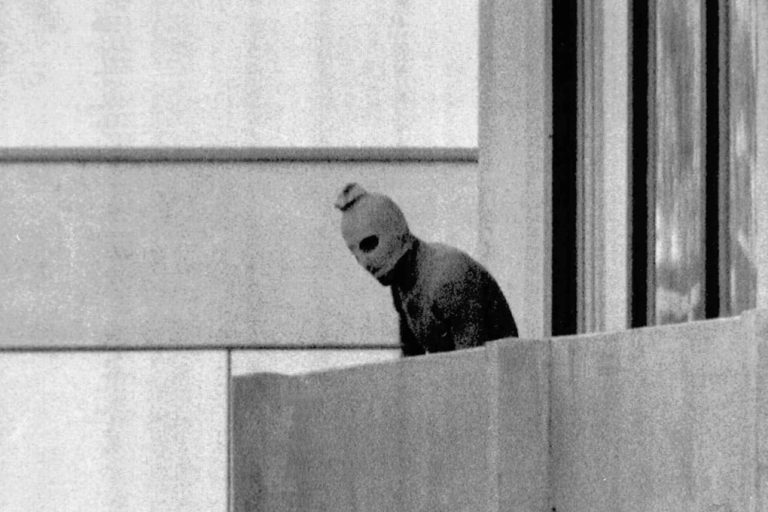

One of the Black September terrorists seen standing on a balcony of the Israeli quarters in the 1972 Olympic Village
“The games must go on” – Avery Brundage, Chairman of the International Olympic Committee
September 5 is a film telling the story of what the sports journalists of ABC went through to tell the story of what happened after Palestinian terrorists took Israelis hostage in the Olympic village at the 1972 Summer Games being held in Munich.
The film opens in the ABC control room with Roone Arledge (Peter Sarsgaard) and Marvin Bader (Ben Chaplin) heading off to sleep and leaving instructions not to call them before 10 AM. Then gunshots are heard coming from the Olympic village and the man now in charge of the control room, Geoffrey Mason (John Magaro) soon learns that Israeli athletes had been taken hostage.
The “head honchos” at ABC want their news operation to take over coverage of this crisis, but Arledge refuses. He has the personnel and resources to cover the situation live and he refuses to give the story to the news people.
There are logistical challenges. The athlete’s village had been sealed off by the German police. An ABC employee posed as an athlete to get film into and out of the village. There is a fear that Peter Jennings (Benjamin Walker) may be removed from the village but that doesn’t happen. His prior experience as a news anchor and foreign correspondent gave the coverage of the crisis more credibility.
The ending of the crisis is well-known to history. The initial reports that the hostages were all safe turned out to be incorrect. There were no highly trained counterterrorism units as there are today, with the exception of Israel’s Sayeret Matkal. In the end, all of the hostages and five of the eight terrorists, along with a West German police office died.
Writer/director Tim Fehlbaum has crafted a docudrama that maintains a very high level of tension while exploring the ethical considerations of covering such events on live television. The acting is excellent with John Magaro’s performance is terrific.
Despite being all about the romantic entanglements of those who partake in the sport, not once does Challengers make that hackneyed observation. This is but one sign you’re in for something greater than expected.
Challengers feels like a sports film from the 1980s along the lines of Bull Durham or Personal Best. When the balls stop flying and the rackets are put down, the real competition begins.
Pro tennis player Art Donaldson (Mike Faist) is in a career slump. Once one of the best in the field, he is now playing a lesser-esteemed tournament as a means of rebounding. He’s up against Patrick Zweig (Josh O’Connor), another once-great player whose career has seen misfortunes.
But, wouldn’t you know it, these two have a history. Thirteen years prior, Art and Patrick were on the same side as doubles partners. The courses of their lives change irrevocably when they meet Tashi Duncan (Zendaya). The Duncanator is herself a top tennis player, up until a serious injury puts an end to that. But off the court, she takes a sexual interest in the pair, who soon compete for her affections in a rivalry fiercer than their sporting one.
The story is another that is told in a nonlinear fashion, flashing backwards and forwards as the script sees fit. I was curious as to what a version of the film re-edited to be in chronological order would be like until I read through the plot summary laid out on Wikipedia which is arranged that way. Quite frankly, it doesn’t land with the same impact. Despite the viewer knowing where some things will end up, there’s still a remarkable sense of tension in keeping certain parts close to the vest.
The focus is squarely on the drama between these characters and not so much the minutiae of tennis. If you don’t know what a junk ball is, Challengers isn’t going to tell you. It also doesn’t feature a supporting cast to speak of, giving the film the feeling of a stage play. This is a three-hander with no weak link.
That said, however, the standout is most certainly Zendaya, whose hold on the audience is as strong as the one Tashi has on her white boys (the character’s words, not mine). She has a mysterious side to her and the actress handles this superbly. Her facial expressions and body language provide a baseline for interpreting her thoughts and feelings but are never so much that they give away her machinations.
But the movie can be too stylized for its own good. Although director Luca Guadagnino does a few interesting things with the camera, he sometimes overdoes it in places where conventional framing and movements would be more warranted. Likewise, the score from Trent Reznor and Atticus Ross is very good but often intrusive.
Nevertheless, Challengers is a more than worthy addition to the neglected tennis film sub-subgenre. Whether you’re getting in the mood for Wimbledon or need a double feature pairing for Wimbledon (though, might 16-Love be a more fitting companion piece?), this film. does more than nicely. Serve it up and swing away.
“The idea of breaking up the country seems so grave, so full of disillusionment, so great a loss to the founding idea of America, that most of us regard it as unthinkable. Most, not all.” – Clay S. Jenkinson
The critical response to Civil War has been so contentious that some may label it a “love it or hate it” movie. I, for one, profoundly disagree with that assessment; it can be found mediocre as well.
To me, Civil War most calls to mind The Purge. Both pictures concoct an intriguing premise that invites curiosity to its world building yet brushes it all aside for a much less ambitious story that seems to only have this element in place as an excuse as to why nobody can call for help.
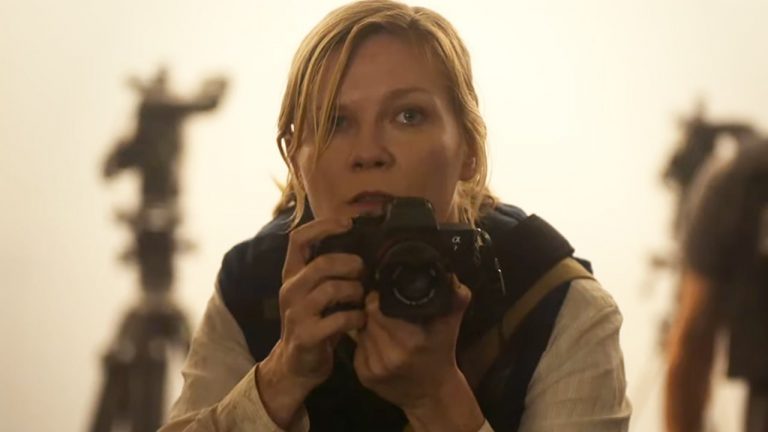
A quartet of photojournalists – two middle-aged (Kirsten Dunst and Wagner Moura), one elderly (Stephen McKinley Henderson), and one young (Cailee Spaeny) – are on a journey to Washington D.C. so they can interview the president (Nick Offerman) before it becomes too late. You see, unlike the conflict of the 1860s, the Union this time does not have the upper hand and is suspected to fall soon. Along the way, they’ll encounter sights of warfare and bloodshed. Some they’ll be eager to exploit for a picture, some they won’t.
As I’m sure every single person who’s reported on this movie has already pointed out, no information is given as to the cause of the war nor the ideological viewpoints of the sides. Yes, there can be times when ambiguity on this or that can work in the film’s favor, but needless to say, this is not one of those times. The whole reason to be interested in a film about a hypothetical second American Civil War is to see how such a thing would be possible. Why it started, what the armies are and what they believe, etc.
The most that we get is a mention that the president is in his third term, but no context is given. What happened to the 22nd Amendment which currently prohibits this? Did he unilaterally seize total power (again, how? Because if that were so easy to do, surely at least one president in the past would have done so already) and that’s why states seceded? Was the war already in progress and, like FDR before him, he thought it best not to change leadership? These things would be very helpful to know.
When some aspects are thought out, they aren’t on screen. For example, the flag for the Western Forces is just the regular American flag but with two big stars on the blue corner. Since the stars represent the states, is the implication that this faction is only comprised of Texas and California? Really? No other states? A map on the Wikipedia page shows that to indeed be the case, but this graphic is absent from the film proper.
And were they to succeed, what would happen then? As we in reality know them, these two states have diametrically different political cultures. How do they hope to function? Or is this only a temporary alliance and each will go their separate ways once the common goal is achieved? These things would be very helpful to know.
All of this said, however, the basic plot works well enough, alternating escalating tensions with quieter moments of reflection. The characters are well-portrayed and go through the proper growth (albeit a tad predictably). Strong shot composition is evident, with a keen eye towards juxtaposing the idyllic with the grim.
The strongest point in the film comes with the arrival of Jesse Plemons, who I really wish the promotional materials kept secret (he is uncredited in the role, a common trait of surprise appearances). While, just like the rest of the movie, we don’t learn much about him or his motivations, he makes an indelible impression as a deranged militiaman that makes his Black Mirror villain look like a saint. He captures the audience’s attention with an iron grip and doesn’t let go until he exits the frame.
But while Civil War will sell you on the acting prowess of Plemons, it won’t sell you on its central gimmick. Why is this setup even necessary? Was it really not possible to tell a story about combat photogs without some nonsense scenario? Questions like these are what need answering before trying to tackle bigger ideas. What needs answering even before that is if there’s a point to it.
“If Satan wasn’t around, churches would go out of business.” – Marilyn Manson
Sacrilege as it might be to say, but try as I might, I have never really liked the Omen films. Even the original, the supposed “good” one, was very badly written, failing to provide a satisfying resolution for the protagonist and audience, resulting in zero underlying message. It strikes one as a clear Exorcist wannabe, made all the more evident when franchise entries pop up right after those from the antecedent. And sure enough, as the seminal series has made its return with Believer, we now have The First Omen.
That title implies something that could have promise, like detailing the account of an Antichrist from centuries ago and how humanity stopped it. Instead, we get an immediate prequel so tiring, pointless, dull, and laboriously (no pun intended) drawn out, ending on a note that’s framed as some shocking reveal when it was obvious from the onscreen text showing the year at the film’s start.
To wit, it’s 1971 and American nun Margaret (Nell Tiger Free) has been sent to Rome to work at an orphanage (as far as she knows, anyway). Before long she takes a keen interest in Carlita (Nicole Sorace), a highly disturbed young girl. And from there things start to go bump in the night, Margaret suspects her superiors have secrets, you know the rest.
It might also be worth noting here that we’ve yet again found ourselves at a point in time when two uncannily similar movies are released against one another. But I have not so much as seen a trailer for Immaculate, so rest assured that this review is not negative because it’s comparing the two. The picture is bad all on its own.
As said in the introductory paragraph, I found the original movie’s writing quite poor, but I still recognized that TheFirst Omen has utterly disregarded, contradicted, and undermined the backstory of that earlier film. A massive retcon that so drastically shifts responsibility (hint: this review’s opening quote was not chosen randomly) is just nonsensical and can’t possibly explain the events (think those of a more supernatural nature) that will unfold. Add to that a tangent seemingly meant to set up a potential side story, except I seem to recall there already being sequels. Wouldn’t these characters have shown up there?
It can be incredibly obvious in so many scenes where they are headed, but the film insists on dragging them out. There’s no suspense in that, just tedium. Add to that several banal bits referencing the 1976 film (though oddly only one of those Final Destination-esque sequences) that serve no other purpose than to be banal references.
If there’s anything that can be said in this film’s defense, it doesn’t completely fail on the acting front. Free is good in her part, evoking the leads in gialli of old. Bill Nighy, Sonia Braga, and Charles Dance are the veterans brought in this time to add some class (which, admittedly, they somewhat do) and collect paychecks.
More than ever, it’s apparent that the people overseeing the Omen films have no clue how to manage them. Just because Exorcist keeps coming back doesn’t mean its imitators have to. Let The First Omen be the last.
“Cities are distinguished by the catastrophic forms they presuppose and which are a vital part of their essential charm.” – Jean Baudrillard
I did not like the last Scream movie and did not have hope that the same creative team would fare any better with a follow-up, especially one produced so soon. Not to mention that horror part sixes are typically really bad and/or forgettable. It feels so good to be wrong.
More than a cut above the prior outing, Scream 6 brings the series back on track and into a whole new dimension.
Following last year’s events, sisters Sam (Melissa Barrera) and Tara (Jenna Ortega) along with their twin friends Chad (Mason Gooding) and Mindy (Jasmin Savoy Brown) have relocated to New York City. The latter three have enrolled in college while Sam works out her trauma with a psychiatrist (Henry Czerny). Sam has become more than a tad overprotective of Tara, which while reasonable considering all that’s happened, causes the junior sibling to resent her presence.
But when Halloween rolls around, someone is dressing up for a different reason. Yes, a killer or two donning the Ghostface costume has started a new rampage and soon makes it clear that the Woodsboro transplants are the true targets. Even when under the protection of veteran detective (Dermot Mulroney), Sam and friends – plus Gale (Courteney Cox), who seemingly now lives here, too – are in grave danger at every turn
Whether it really was due to pay disagreements or fear that the undignified treatment other returning characters received in part five would happen to her, Neve Campbell declined the chance to return. However, as the television series proved, the franchise is perfectly fine without Sidney. The cast members really come into their own and finally make the impressions they didn’t before. They’re so good I’m almost tempted to go back and watch the previous film.
While the last installment unfairly took away some legacy characters, this time we get one back from the dead. Kirby (Hayden Panettiere) is now in the FBI and has jumped on the case. It’s a real treat to see her again; she might even be better here than she was in Scream 4. In other pluses, the 3D helps greatly to heighten the viewer’s engagement and sense of environment. More importantly, the narrative is leaps and bounds better than the one before it. There are some really welcome swerves and a villain or more who are worthy of the mask.
The apparently mandatory rules explanation scene feels a little off. It really should have been for the “in New York” installment, which is weirdly a pretty common trope. Friday the 13th Part 8 gets a subtle nod earlier on, but Die Hard, Home Alone, The Muppets, and even Sharknado (featuring yours truly) have done it as well. Instead, the focus is on franchises. Most everything that’s said is much more applicable to the previous film than this one. There is a bit of self-awareness when Mindy criticizes some of the things that the fifth did, which feels a bit vindicating. Then again, admitting you did a crappy thing doesn’t excuse you for having done it in the first place.
A few more flaws are apparent. Once again, the racial dynamics go completely unexplored. The supporting cast is a little thin, making it easier to narrow down the unsub(s). Lastly (though not a fault of the film itself but whoever is responsible for releasing it), shouldn’t a film set on Halloween come out closer to October 31 and not over a half-year away?
Going in, I didn’t imagine saying this, but I am intrigued to see where this series gets taken next. Perhaps next time we’ll get to meet Sam and Tara’s suspiciously-absent mother (casting ideas time: Michelle Rodriguez, Sara Ramirez, Judy Reyes, someone else whose surname begins with an R), or, wishful thinking here, we could see a crossover with some of the TV cast. In any event, bring on Scream 7 and whatever way that number will appear in the logo.
Chadwick Boseman in Black Panther: Wakanda Forever
“When the music changes, then the rhythm of the dance must change also.” – Tuareg proverb
Five years ago, Black Panther was a rousing success the likes of which the world had never seen. The often overlooked Marvel comics character was now in the stratosphere of the company’s biggest creations. Naturally, a sequel was called for and audiences were excited to see what T’Challa would face next. But the cruel whims of fate had other plans.
With the tragic loss of the star and no clear direction on how to move forward, it would have been more than understandable to cease production. However, Ryan Coogler rose to the occasion and soldiered on, crafting Black Panther: Wakanda Forever. This is a picture that is more than just what could best be made under the circumstances.
Though it has become a major player in global politics, the African nation of Wakanda is reeling from the death of its king (Chadwick Boseman, seen in flashback footage and a touching opening logo sequence). His mother Queen Ramonda (Angela Bassett) has assumed rule while Princess Shuri (Letitia Wright) steps out of the lab to take a more active role. And rule the Queen does, making it crystal clear that her country is not to be messed with.
Meanwhile, searches for vibranium in the Atlantic Ocean have disturbed Talokan, an underwater kingdom that had also been living in isolation. After leading an attack on invasive American forces, their leader Namor (Tenoch Huerta) reveals himself to Ramonda and Shuri. The Sub-Mariner requests Wakana’s assistance in tracking down the party responsible for the detection device. Understanding that their nation will very likely be blamed by the world for the aggression, the Wakandans are put in a difficult position.
The themes of the prior film dealt with loyalty and tradition, and while those may crop up here and there, Wakanda Forever has its own points of focus. Chiefly, these are leadership, family, faith, and, of course, grief. The handling of T’Challa’s death was dignified, reflecting every bit the love those involved in the production had for the character and his actor.
Talokan is developed as a strong parallel to Wakanda, complete with its own cultural touches such as catchphrases and gestures. The color coding of the subtitles to correspond with the languages being spoken (e.g. the Wakandan translations are in yellow while Spanish are in white, etc.) is pure brilliance. With this script, Coogler and co-writer Joe Robert Cole are even bolder than before. Put it this way: the first film alluded to past atrocities, but the second outright shows them. Other key creatives – namely costume designer Ruth Carter and composer Ludwig Göransson, both of whom earned Academy Awards for their work on the predecessor – return to provide equally proficient work.
And also like the first, the actors and characters shine. Shuri makes for a compelling protagonist and Wright rises admirably to the occasion. Bassett is Oscar-worthy, digging into her character’s deepest pathos and emerging as an absolute tour de force. Also back are Lupita Nyong’o and Danai Gurira, looking better than ever and with a solid grasp on their roles. Michaela Coel, while not given as much to do, makes for a superb addition to the Dora Milaje. Though he does still seem a bit miscast (or maybe it’s the facial hair and lack of a ponytail throwing me off), Huerta has what should be a star-making turn.
And then there’s Riri “Ironheart” Williams (Dominique Thorne). As her alias suggests, she was developed in the comics as an heir apparent to Tony Stark. However, since the movies have already used Spider-Man to fill that purpose, she is stripped of that connection here. And really, having Shuri as a mentor is a much better fit anyway. Shuri sees in Riri a younger version of herself and the audience sees that Shuri has grown from the kid sidekick to the main hero.
The flaws are primarily Namor-related. His origin is vastly different from that of the comic character. While this may have been done because Aquaman beat them to it, surely Marvel could have found a unique angle for an Atlantis of their own. In addition, the secondary villains are not very well-defined, so scenes where the audience is supposed to recognize them don’t land.
Proving that lemonade can be made from life’s lemons, Wakanda Forever is a strong and emotionally resonant continuation. It is unknown where the series will go from here, but the bar remains high. I have no doubt, however, that should the same team of talent remain on this property, they will meet the challenge admirably.
“The miracle isn’t that I finished. The miracle is that I had the courage to start” – John Bingham
Miracle is a word that is overused in sports journalism. We all remember the Miracle On Ice when the USA defeated the Russian hockey team at the 1980 Winter Olympics. Others include the Minneapolis Miracle, the Monday Night Miracle, the Miracle at the Meadowlands and of course my personal favorite, the Miracle on Manchester.
That being said, All In: Miracle at St. Bernard’s is not an overuse of the term. This finely crafted documentary tells the story of an undermanned high school football team and the battle to save the small Catholic High School that those football players played for. The school’s name perfectly fits the narrative of this documentary film. Bernard of Clairvaux, who is now known as St. Bernard was the co-founder of the Knights Templar.
St. Bernard’s is located in Fitchburg, MA, a city of less than 43,000 people. In 2018 the football team had less than 37 players on it. Many of them were having to play what’s known as “Ironman” football, meaning that players were playing both offense and defense. As they were making their way through the regular season and then the playoffs, the goal was to win the State Championship. That would be a miracle.
Another issue arose. Latin teacher Linda Anderson was hired as the new principal. Not long after she took the helm, the diocese told the school would be closing at the end of the year. That news did not sit well with Ms Anderson, a number of parents and some of the alumni. They held a meeting and came up with a plan to save the school. The plan was to make the school independent of the diocese. In order to pull off that miracle, they had to accomplish two objectives. One was to get at least 100 students enrolled for the upcoming year. The other was to raise enough money to put the new, independent school on a sound financial footing. Tall orders indeed. According to data compiled by the National Catholic Educational Association, enrollment in Catholic schools has been declining since 2001.
St Bernard principal Linda Anderson
Director Gregory Backer intertwines the struggle of winning a state title with the work of the students, parents, administration and alumni to preserve a school that was coming up on its centennial anniversary. It was an integral part of the life of the community, and they would not give it up without the best fight they had in themselves.
Watching this film was pure pleasure. It may be the best high school documentary since 1994’s Hoop Dreams. Backer and writer/producer Evan Kanew bring even the smallest nuances of both stories to life on the screen. Maybe their backgrounds as high-level high-school athletes helped. Maybe it’s just talent and experience. They put the motivational skills of football coach Tom Bingham front and center. We see them in his talks with his team, his comments about his team and in how he conducts himself. We’re introduced to Linda Anderson, who had no experience in school administration before being appointed as the school principal. In fact, it may well be that her lack of experience enabled her to not see the battle to save the school as an unwinnable battle. In the words of the late Colin Powell, “perpetual optimism is a force multiplier.” This documentary is a winner.
“Whether we attack or stay, there is only death” – Lt. General Yoshitsugu Saito, commander of the Japanese forces on Saipan. He took his own life during the final battle for control of the island.
What really happened: On July 7, 1944, the Japanese Imperial Army was pinned down on the island of Saipan with nowhere to retreat to. Their response to the predicament was to mount the largest “banzai” charge of World War II. Over 4,000 soldiers charged at the Americans. They inflicted heavy casualties on the American troops. In the end, the Japanese soldiers were wiped out.
Writer/Director Brandon Slagle’s Battle For Saipan examines that large scale charge with one small slice of what happened that day. The setting is an aid station for the care and treatment of wounded U.S. military personnel. The facility is commanded by “General Jake Carroll” (Jeff Fahey, Wyatt Earp, Machete). He runs the station by sitting in his office, listening to music and drinking alcohol; occasionally giving counsel and wisdom to the medical professionals.
“Vic” (Casper van Dien – Starship Troopers, Alita: Battle Angel) is one of the surgeons assigned to the station. When word gets out that the Japanese are approaching en masse and that no help is on the way, Vic connects with “Major William Porter” (Louis Mandylor – Rambo: Last Blood), who is only at the aid station because he carried a wounded soldier there. Major Porter is an expert in killing others with almost any weapon imaginable. They organize the patients, the nurses and the staff to defend the aid station the best that they can.
Casper Van Dien in Battle for Saipan
The rest of the film’s 94 minutes is an almost continuous battle, with only short lulls in the fighting used to explore these men and women who are bonding over their desire to save one another’s lives. It is an intense bond that forms among people engaged in battle against a common foe. We see selflessness and sacrifice as the number of survivors among the people inside the aid station dwindles.
There is heroism to be found among the combatants. The action sequences are taut as well as engrossing. Lighting and editing are first-rate. I suspect there may be some additional footage that we might be able to view once the film is released on DVD/Blu-Ray. I want to see it again, on a big screen with better sound.
“You don’t need a silver fork to eat good food” – Paul Prudhomme
In The Menu, from director Mark Mylod, you actually need to be able to afford a gold fork in order to dine at Hawthorne. The cost of the prix fixe meal at this exclusive establishment, located on a private island is $1,250 per person.
The patrons come to Hawthorne to dine on the creations of “The Chef” (Ralph Fiennes – Spectre, The Grand Budapest Hotel). He encourages the people seated for the meal to “taste” rather than just eating the food. “Margot Mills” (Anya Taylor-Joy – The Queens Gambit) is there on this evening with “Tyler” (Nicholas Hoult – Warm Bodies, X-Men: Dark Phoenix) who is a serious foodie and fanboy of The Chef. As we learn early on, she was not his planned date for this evening but a last-minute replacement.
There are others at Hawthorne on this special evening. Noted food critic “Lillian Bloom” (Janet McTeer – Me Before You, Tumbleweeds) was personally invited by The Chef. She had been instrumental in his career when he started out as a chef. Other guests in the dining room are an actor whose best career roles are behind him now (John Leguizamo) and his beautiful and intelligent assistant (Aimee Carrero); three men who work for the investor behind the creation of Hawthorne, and a wealthy man and his wife. The wife thinks that Margo looks familiar.
Ralph Fiennes as “The Chef” supervising his kitchen staff in creating his masterpiece meal
The guests are led on a tour of the island upon arrival. Their tour-guide and restaurant captain “Elsa” (Hong Chau – Downsizing, American Woman) shepherds the diners to their tables and manages their movements.
Each course is a revelation to the patrons and not in a good way as The Chef’s true menu is revealed; in a clever way using a portion of one course of the meal. To avoid spoilers, I will write no more about what happens next. Suffice it to say, there are more twists and turns as the meal moves on.
Anya Taylor-Joy continues to dazzle in her performances and the camera loves her madly. What I enjoy in watching Ralph Fiennes act is that there is an element of similarity in most of his performances and yet they are all decidedly different at the same time. John Leguizamo delivers an over-the-top performance, but that is precisely what is needed from his ‘has-been’ character. Conversely, the talents of Judith Light are utterly wasted in her all too brief time as the focus of attention.
Because of the dark nature of the subject matter, when and where to use darker lighting is important. This is something Mylod does well. Food movies require the display of food items that are exquisite in appearance, and that look incredibly delicious. The presentation of the courses is spectacular, but they are so esoteric in nature that I had no desire to ingest any of them. Except perhaps for one item that The Chef lovingly prepares near the end of the film.
Danielle Deadwyler (left) as Mamie Till Mobley and Jalyn Hall (right) as Emmett Till in ‘Till.’
“Prejudices can kill, and suspicion can destroy. And the thoughtless frightened search for a scapegoat has a fallout all of its own for the children and the children yet unborn.…” – Mamie Till-Mobley
In the summer of 1955, Mamie Till-Bradley (Danielle Deadwyler) was a war widow and the single mother of 14-year-old Emmett Lewis Till (Jalyn Hall). Mamie is struggling with being apart from her son during his upcoming trip to Mississippi to visit his cousins and their parents. In 1955, Chicago was so vastly different than Mississippi in how Negroes (the vernacular used in the movie) are treated. Mamie tries to prepare Emmett for this vast difference, but her warnings are not getting through.
It is not a spoiler to review what happened to Emmett in Money, MS. It is an indelible stain on our nation’s history. What exactly happened inside the store where Carolyn Bryant (Haley Bennett) was working when Emmett entered, is in dispute. So is exactly how she reacted in the aftermath of the encounter with Emmett.
Bryant’s husband Roy (Sean Michael Weber) and his half-brother John William “J. W.” Milam went to the home where Emmett was staying. They kidnapped him at gunpoint and drove away. The body of Emmett Till was not discovered until three days later.
Director Chinonye Chukwu, who co-wrote the screenplay with Michael Riley and Keith Beauchamp is telling the story of what happened after the discovery of Till’s body in this film. How the decision of Mamie Till-Bradley to hold an open-casket funeral for the son everyone referred to as “Bo” changed the landscape of race relations and civil rights in the U. S. We are treated to the spectacle of a totally unfair trial, with the blatant bigotry of the era in the Deep South on display for all to see. Medger Evers (Tosin Cole) played a pivotal role in assisting Mamie during her trip to and time in Mississippi for the trial.
Danielle Deadwyler in ‘Till.’
Till is two hours and ten minutes long. That this writer did not glance at his watch once during the film is the strongest indication available f how captivating and engaging this movie is. Chukwu uses lighting in an unusual and effective way, not removing reflected light on windows and other items to give a more “real” appearance. She also uses going from poorly lit to brightly lit in a single shot, giving those scenes a nice aesthetic appearance.
All of that aside, this is a Danielle Deadwyler career-making performance. She takes us through highs and lows of a mother dealing with the murder of her son by seamlessly navigating the wide range of emotions she is experiencing. It is an incredible performance that is deserving of awards season recognition.
One other component of Till is that there is no “white savior” present anywhere. Perhaps someone who has not lived in Mississippi will be troubled by the pervasive racism among all of the white characters who have dialogue. I’ve lived there and seen it first-hand. It adds realism.