
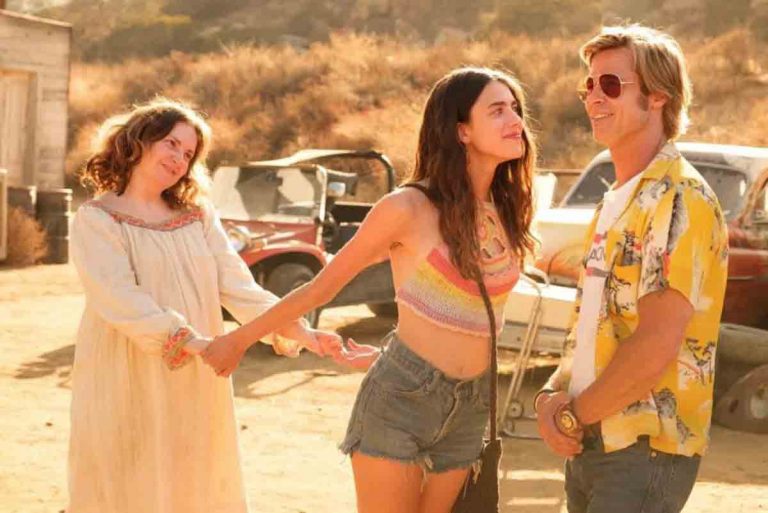
Lena Dunham, Margaret Qualley, and Brad Pitt in Once Upon a Time in Hollywood
“You expected Charles Manson at the very least, didn’t ya?” – Randall Flagg
July 26 of 2019 brought us the latest film from a very interesting auteur. This self-taught professional has a vast knowledge of foreign and exploitation films that serves him well in providing homages and commentary. It’s funny, thrilling, and well-acted, one of his strongest efforts yet. Brad Jones really did do a great job with Another Cinema Snob Movie. Oh right, a new Quentin Tarantino movie also came out.
Once Upon a Time in Hollywood, I am unhappy to report, is a letdown. Treating its subject matter in a very ill-conceived manner, it represents how a diverted focus can mar so much potential for greatness.
It’s 1969 and Rick Dalton (Leonardo DiCaprio) is an actor sliding into irrelevance. He keeps employed in western TV shows here and there, but he’s not seen as the leading man material he once was. His stunt double and best friend Cliff Booth (Brad Pitt) is finding his own employment difficulties. After a while, they’ll need to consider their options in how to best move forward to reinvigorate their careers.
On a parallel track is Rick’s neighbor Sharon Tate (Margot Robbie). Yes, that Sharon Tate. Which means Charles Manson (Damon Herriman) and the Manson Family are around too. Cliff runs into them when picking up Kathryn Lutesinger (Margaret Qualley) and giving her a ride back to the ranch. Things don’t go quite so smoothly there, giving the cult a new target.
As has come to be expected of him, Tarantino has assembled a very impressive cast that can rival any Avengers lineup. In addition to those mentioned, there’s Kurt Russell, Lena Dunham, Damian Lewis, Dakota Fanning, Michael Madsen, Al Pacino, Bruce Dern (subbing in for Burt Reynolds, who died before he could film his part) and Luke Perry (who died not long after filming; does this movie have a curse or something?). There’s certainly more to be on the lookout for, and they’re all wonderful to watch in action.
Had this movie been entirely about Rick and Cliff, it could have been great. The two men succeed in their parts and play off each other superbly. How it handles showbusiness in this era is also interesting, presenting a (b-)side of pictures that rarely gets explored on this level. The attention to detail in the recreations is fabulous. But to the film’s detriment, that isn’t the only story being told here.
The treatment of the Manson stuff truly does ruin things. Tate and the Family really should have been dropped entirely, or at least replaced with fictional analogues. It’s going to be hard to discuss this without verging on spoilers, but to say that what happens in the movie wasn’t what happened in reality is a colossal understatement.
Robbie is fine as Tate, but overqualified for the role. A lookalike actress who does reenactments on ID channel shows would’ve done just as well. Same goes for the Family, though they actually do consist of a couple actors who have impersonated their parts before.
The events of the ending are where things really go off the rails. What happens there does use these figures, but ultimately they specifically are entirely irrelevant and should have just been replaced with invented stand-ins. But as is, it’s not a thoughtful presentation of the matter. In fact, it can be read as downright insulting to the victims of the Tate-LaBianca murders and probably does as much a disservice to the events as The Haunting of Sharon Tate did. Not only that, but it completely invalidates earlier scenes that were meant to be poignant. All impact those parts were supposed to have is promptly stripped away and renders them as utterly pointless.
Then there’s the depiction of Bruce Lee (Mike Moh), which also should never have been included. In this film, he’s an absolute jerk who then gets into a fight with Cliff who handles him with ease. I can somewhat understand wanting to demonstrate Cliff’s military training, but why couldn’t this have been done with a fictional character? There has to be a better way to build him up without tearing down someone who means so much to so many.
Lastly, places where the writer/director gets in his own way stick out quite a bit. There’s a part when Rick is shooting with a child actress (Julia Butters) where he, ignoring the script, places her in danger. However, she was prepared for it and thus Rick is vindicated (never mind that there was no way for him to know that). This really feels like an awkward defense from Tarantino on the Uma Thurman situation. And the displays of his rather infamous fetishes are just shamelessly blatant (though we see DiCaprio’s soles probably as much as the ladies’, so I suppose equal opportunity is some progress).
A proper examination into one of the most horrific crimes in recent history Once Upon a Time in Hollywood is not. Whatever real-world tragedy Tarantino decides to exploit next (9/11?), he ought to exercise some better judgment.
“We’re not in Wonderland anymore Alice” – Charles Manson
“My whole life has been decided by fate” – Sharon Tate
The ninth film from writer/director Quentin Tarantino is Once Upon a Time in Hollywood. It draws inspiration from people and events that transpired between February and August of 1969. But it is fiction and that should be remembered from the outset.
It was the time when Charles Manson (Damon Herriman – The Lone Ranger) was operating out of the Spahn Movie Ranch in the San Fernando Valley. When the career of Sharon Tate (Margot Robbie – I, Tonya) was advancing after her strong turn in The Wrecking Crew. When “Rick Dalton” (Leonardo DeCaprio – The Wolf of Wall Street) is seeing his career as an actor going into a steep decline. When “Cliff Booth” (Brad Pitt – (The Big Short) may no longer be able to make a living as Rick’s stunt-double/driver-factotum.
Rick Dalton was the star of a 1950s western TV series titled “Bounty Law.” But in 1969 his career is doing one-offs as the ‘heavy’ on TV westerns. While his star has declined, he made one very smart move early in his career. He’d purchased his home on Cielo Drive in the exclusive Benedict Canyon area of Los Angeles.
Leonardo DiCaprio in Once Upon a Time in Hollywood
Then “Marvin Schwarz” (Al Pacino – Stand Up Guys) enters Rick’s life. He’s seen Rick in an episode of “The F.B.I.” and says that Rick could do well making spaghetti westerns in Italy. Given the opportunity to pad his bank balance, he takes Cliff along for the adventure. After making four movies in six months, Rick comes home with a new wife, “Francesca Capucci” (Lorenza Izzo – Aftershock).
Before going to Italy, Cliff had seen “Pussycat” (Margaret Qualley – The Nice Guys) several times while driving around Hollywood. She was always hitchhiking and Cliff finally offered her a ride. He drove her out to the Spahn Movie Ranch. He’d worked there in the 50s on Bounty Law. Things went well until he insisted on saying hello to George Spahn (Bruce Dern – Nebraska) who owns and lives on the ranch. Pussycat tells Cliff that George is napping. So does Lynette “Squeaky” Fromme (Dakota Fanning – Ocean’s 8). After he finally sees George, who does not remember him, Cliff encounters some difficulty departing the ranch. But he finally leaves in Rick’s Caddy.
What really happened on August 9, 1969? Manson Family members Charles Denton “Tex” Watson Jr, Susan Atkins, Linda Kasabian and Patricia Krenwinkel drove to the home at 10050 Cielo Drive. The home shared by Roman Polanski and Sharon Tate. On this night, Polanski was in London working on a movie. Tate was home with Jay Sebring, Wojciech Frykowski and Frykowski’s girlfriend Abigail Folger. The four were brutally murdered, along with 18 year old Steven Parent. Tate, who was roughly two weeks away from giving birth was stabbed 16 times.
The ending of QT’s fictional story has nothing to do with that reality. I won’t spoil it, other than to say it is one of the best sequences of brutal violence in any of his films.
If there was a word stronger than homage to use, I would use it. This film is QT’s homage to Hollywood, schlock movies and TV shows, and the music/ambience of that era. The use of music and DJ sound/jock shouts from 93 KHJ’s “Boss Radio” are inspired. Margot Robbie is underutilized but still wonderful as Sharon Tate. The chemistry between DiCaprio and Pitt is so good that I wonder why no one paired them up before. There are a few anachronistic errors, most notably the presence of Tate and Polanski at a party at the famed Playboy Mansion. Hugh Hefner did not purchase that magnificent property until 1971. But those are minor quibbles that do not detract from the awesomeness of this cinematic achievement.
Christopher Walken, Alan Arkin and Al Pacino are the ‘Stand Up Guys’
If Stand Up Guys, the new light crime noir that marks Fisher Stevens’ second stab as a feature film director, were a person, it would be a voyeur. This is most certainly a film that likes to watch.
And who would blame him for that when one’s subjects are such mega-ton Oscar winners as Alan Arkin, Al Pacino, and Christopher Walken? Based on a script by Noah Haidle, Guys is so busy watching that it doesn’t stop to give much information away. We hardly know where it takes place, and would it not for references to Viagra, outfits and use of landlines make it so that the film could have easily occurred 30 or 35 years earlier than its modern setting. Pacino plays Val, a thug recently released from prison (how many times has Pacino now played an ex-con? I count roughly 14 billion) after serving a 28-year sentence for the unintended murder of the son of local crime boss Claphands (Mark Margolis, menacing underused). Claphands intends for Val to be killed as revenge for his son by Doc (Walken), Val’s best friend and (literal) partner in crime.
With Doc’s George to Val’s Lenny, the two embark on a day and night on the town, including several trips to a local brothel, to Doc’s favorite diner, a raid on a closed pharmacy, a couple of unplanned trips to a nearby hospital so Julianna Margulies can show up as a nurse, and even a cemetery. This film is more of a due than a trio; Guys is mostly a showpiece for the two actors, with Pacino exercising his frenetic side, although not inappropriately, and Walken in a sadder, more contemplative role that benefits from very careful modulation and restraint. Arkin, whose character, Hirsch, enters and exits the film pretty much exactly as you might predict, takes a (not literal) backseat to his two co-stars. Addison Timlin shines in the small but significant role of a waitress at Doc’s diner. (Which brings to mind a logistical question: how many times in the course of a night can these guys scarf down all that food and coffee?
The thrill of the movie is to sit back and watch these veterans do their thing. It’s a bittersweet victory lap, as age allows them to inject a greater gravitas into every moment but also tinges their scenes with a sense of finality. Decades ago these talented men represented a new guard of vitality and realism in acting. We’re now reminded me that all things, even the most illustrious and door-opening of careers, must come to an end. Guys aches with decay and loneliness, and even Doc, Hirsch, and Val know their days are numbered. Stevens lays on the pathos a bit too thick, though – these flawed guys are so sympathetic and omniscient that they begin to adopt the deity-like qualities we all want to attribute to their portrayers.
And as long as Guys remains full of hero worship, this star vehicle isn’t doing its job. It’s looking backward when it should be moving forward. Haidle’s script includes many moments that wink back to the past, including a joyride in a speeding car and Pacino dancing with a stranger in a bar, both of which call back to Martin Brest’s Scent of a Woman. Guys also loves quoting Rowdy Roddy Piper’s big line from John Carpenter’s They Live. And the film is consumed by tropes involving these randy men getting their rocks off – think Cocoon meets Porky’s.
And after a while, Guys’ jejune humor takes its toll. Pacino’s shamelessness begins to feel, well, shameful, especially as he swallows Viagra by the fistful, not unlike his Tony Montana once dove into a hill of cocaine. 40 years ago we were introduced to a young Pacino as Michael Corleone struggling with a gun. Now he’s popping Viagra to load a very different kind of pistol. Is that how Pacino really wants his career to climax?
Jack Lemmon and Kevin Spacey in ‘Glengarry Glen Ross’
Even as Quentin Tarantino continues to ride a tide of popularity for his witty, self-consciously hip banter, there is still one undisputed, heavy weight champion of brilliant screen dialogue.
David Mamet.
Mamet’s been perfecting his trademark patter since his theatrical hits Sexual Perversity in Chicago and About Last Night in the mid-seventies, through his work on Hill Street Blues for television, and his successful film adaptations of The Postman Always Rings Twice and the Paul Newman classic The Verdict, for which he was nominated for his first Oscar (Best Screenplay Based on Material from Another Medium, 1982).
Mamet’s career has been checkered. For every popular hit like The Untouchables, there are several critically acclaimed works like House of Games and The Winslow Boy, or woefully under-appreciated efforts like The Edge that struggled to find an audience. Even after rising to the level of Hollywood royalty, Mamet’s work remains an acquired taste; a full meal, heavy on red meat and bitter vegetables served to a population weaned on a diet of comfort food.
Mamet’s most talked about film to date is the cult favorite Glengarry Glen Ross. And for good reason. Set in the arena of real estate sales, Glengarry is Mamet at his finest; an unflinching, foul-mouthed journey into the lives of desperate men fighting for their jobs, and by extension, their lives. Based on Mamet’s Pulitzer Prize-winning stage play of the same name, Glengarry Glen Ross contains some of the most memorable and quotable dialogue in the author’s long career. For those unfamiliar with “Mametspeak,” Glengarry is a fine introduction.
“You’re talking about what?” asks a superior of his sales staff. “You’re talkin’ about — bitchin’ about that sale you shot, some son of a bitch don’t wanna buy land, somebody don’t want what you’re sellin’, some broad you’re tryin’ to screw, so forth? Let’s talk about something important.”
Classic Mamet — terse, profane and in your face. Mamet’s dialogue doesn’t strive for realism, it rises to the level of working-class poetry. Characters interrupt themselves and restart their sentences mid-thought, speak in telling fragments, etc. It’s precise, musical, driven as mush by rhythm as language.
“The good news is, you’re fired,” the superior barks at his subordinates. “The bad news is you’ve got — all of you’ve got — just one week to regain your jobs, starting with tonight, starting with tonight’s sit!”
A former real estate salesman, Mamet fills Glengarry with the language of the game. A “sit” is a business meeting. A “closer” is someone who sells, or, more literally, closes deals. “Leads” are just that, vital information about potential clients. It’s the leads that matter. Give your sales force bad leads and you’ve tied their hands.
“The leads are week,” one worker protests.
“The leads are weak?” barks the superior. “You’re weak! You can’t play in the man’s game? You can’t close ‘em? Then go home and tell your wife your troubles! ‘Cause only one thing counts in this life — get them to sign on the line which is dotted. You hear me, you fucking faggots?!”
Get the picture? An acquired taste, to be sure. If you like your characters sympathetic, and your storytellers guided by a moral code, then you’ve wandered into the wrong mall.
Shot for twelve million and given a limited run, the film grossed less than eleven million dollars, despite rave reviews. Since its release on video, the film has enjoyed a second life, earning a cult following that it still enjoys today.
For those brave — or strong — enough to hang on for dear life, Glengarry Glen Ross is a masterwork not to be missed. Working with little more than two interior locations, Glengarry proves that less can be more (much more!), that well-written conflict is more engaging than an hour of special effects, and that smart, dialogue-driven films — like the great films of the 40’s and 50’s — can still blow you away, even when there’s little more going on in the frame than conversation.
In addition to Mamet’s writing, and helmer James Foley’s unobtrusive direction,Glengarry‘s success is due, in no small part, to the brilliant performances of its stellar cast. Attracted by Mamet’s work, and eager to work in collaboration with each other, Al Pacino, Jack Lemmon, Kevin Spacey, Alec Baldwin, Ed Harris, Alan Arkin, and Jonathan Pryce all cut their rates to be a part of the production. Of these, Pacino was the most instrumental in getting the project to the screen.
According to Foley, Pacino saw the play, loved it, and got his hands on Mamet’s screenplay adaptation. Pacino’s intention was to play Ricky Romer, the highest rated salesman in the lowly rated pool (Baldwin gives a different take on Pacino’s commitment to the project in his audio commentary in a bit of telling gossip — telling, that is, of Baldwin). It was Pacino, says Foley, who suggested casting Lemmon.
“This was a time when Jack Lemmon’s was very dicey,” Foley recalls in his audio commentary. “He was still a vital, vibrant actor in the scheme of things, but he had not been in a successful movie in a couple years. So to suggest that he be one of the stars of this movie with Pacino — who was riding high — was not met with enthusiasm.”
While Lemmon’s involvement in the project didn’t light anyone’s fire at New Line, the actor’s commitment meant the world to his peers. With both Pacino and Lemmon attached to the property, the other actors eagerly signed on, and the rest is history.
Each actor brings a unique voice to the production. Pacino is cunning and seductive as the company’s best salesman. Baldwin is eviscerating in his one, show-stopping scene as the condescending superior. Arkin, as always, is solid as the group’s least committed member. Harris is the epitome of the seething professional desperate to re-establish his manhood. Spacey is strong as the cold-hearted company shill with a mean streak, and Pryce delivers the film’s most subtly tortured performances as a fly caught in the web of the company’s biggest spider. But it is Lemmon — the man the studio didn’t want from the get go — that turns in the film’s most heartbreaking performance as an unprincipled salesman unraveling at the seams.
On his commentary, director Foley recalls that the Glengarry Glen Ross set was the least tense set of any film he’d ever worked, despite the on screen acrimony… with one exception.
“I remember that I would come in,” Baldwin says, “and they were all around the coffee urn having coffee and laughing and I walked up, and all the laughing stopped.” Foley recalls the same. “They treated him like shit, which was great,” the director tells, “because it motivated him to treat them back as shit. It wasn’t about Alec at all,” Foley clarifies. “It was about his character.”
From the beginning, all the actors agreed to do Mamet’s screenplay word-for-word; the author’s idiosyncratic dialogue would never work as a whole if any one actor tried to paraphrased it. “We had a script supervisor on the set,” Arkin recalls. “If I had a line that was, “uh…uh…uh,” and I only did two of them, I would get stopped. ‘I’m sorry, there are three of those.’ It was the most exacting work I’ve ever done in my life.”
In addition to the brilliant film, the ten-year anniversary edition DVD is loaded with extras. Compiled after Lemmon’s death, the 2-disc set features a loving tribute to the actor in the form of talking heads interviews with professionals who worked with or knew Lemmon personally. Fittingly, Chris Lemmon, the actor’s only son, begins and ends the tribute titled “Magic Time”, an expression the senior Lemmon often used before shooting his scenes. The similarities between Chris and his father are startling, and the adoration he expresses for his dad is quite moving.
As universally loved and admired as Jack Lemmon was, it does feel odd that more people weren’t brought in for the tribute, most notably the muscle-bound, African-American actor Ving Rhames who, after winning his Best Actor statuette at the Golden Globe Awards three years earlier, tearfully called Lemmon to the stage and gave it to him in exchange for the veteran’s influence on his career. Too bad.
The DVD also features commentaries from director Foley, Alan Arkin, Alec Baldwin, cinematographer Juan Ruiz Anchia, and production designer Jane Musky. An odd detail to note is that none of the commentaries is feature-length. Each commentary jumps abruptly to scenes later in the film, making one suspect their DVD might be damaged. Perhaps the editors of the commentaries felt as DP Anchia did.
“A lot of times you see a book about a photo and how captured it,” Anchia shares, his Spanish accent thick. “And he’s so — intellectual. And you say, well, sometimes you just got the picture. Why to talk more about it? And in films it’s the same. It’s the nature of the moment. You just got it. Why intellectualize the moment?”
The DVD also includes a clip of Jack Lemmon on “Charlie Rose” discussing Glengarry, and a second clip from “Inside the Actor’s Studio” featuring Kevin Spacey interacting with a second year student during that show’s Q&A.
Jeff Margolis, the student in question, has to go down in history as the poster child for hutspa. The previous year when Spacey appeared on the program, Margolis convinced the two-time Academy Award-winner to perform a line from Glengarry. This time around, Margolis convinces Spacey to play part of a scene from Glengarrywith him. It’s a moment that brings down the house, and tickles Spacey — an actor who, by his own admission, jump-started his career with a series of profoundly shameless overtures. In the end, Margolis not only plays the scene with Spacey, but he gets his brass balls moment immortalized forever on the anniversary DVD!
Extras also include a second talking heads documentary featuring lifelong sales people titled A.B.C. (or “Always Be Closing,” the Baldwin character’s command at the head of Glengarry), and a short, 1947 documentary on zealous, Pennsylvania furniture salesman J. Roy. More than A.B.C., Roy’s footage gives viewers their best glimpse into the kind of charismatic, sincere personality that happily chooses a lifetime in sales.
Other features include wide and full screen options, DTS and Dolby Digital sound, English and Spanish subtitles, production notes, cast & crew biographies and an odd little Easter Egg. Go to the Special Features page, highlight the Main Menu option and click the Left button to highlight the bar sign in the Chinese restaurant. Click that and you’re lead to a series of unknown actors taking Baldwin’s abusive monologue out for a spin. Though a case can be made for the difficulty of performing Mamet’s dialogue, it seems mean-spirited to martyr hopefuls obviously out of their depth to make the point.
The one genuinely entertaining moment comes at the end of this extra. One of the actors, an Asian-American, turns to the camera and begins the monologue again in Japanese. Rather than going big with the line, as Baldwin did in the film, the actor delivers her reading with ice in her voice. Though obviously tagged on as a hoot (the moment begins and ends with a gong), it’s a great, telling bit that demonstrates just how chilling Mamet’s intention can be in any language.